Thursday, 18 April 2013
Wine and Cheese Night: A Face Like Glass by Frances Hardinge
A Face Like Glass - Frances Hardinge
A Face Like Glass is Frances Hardinge's Kitschie's Red Tentacle nominated book. Its the first of hers I've read, having received rave reviews from Tom Pollock and being nominated for the Kitschies, I felt I had to. I stumbled across a signed copy in Forbidden Planet and it jumped straight to the top of my TBR. an intriguingly fantastic story about twisting, fractured urban spaces? With novel ideas and wonderful worldbuilding? Count me in.
Hardinge's heroine, Neverfell is a mixture of archetype and atypical heroine, a curious blend of (potentially) fatally flawed and prophesied outsider (without the prophecy), come to change the world forever. As a YA novel, I wasn't expecting the nuances and subtlety of Neverfell's heroic character. She lives in a world where every face must be learnt: the more powerful and rich you are, in general the larger the range and subtlety of your facial range. She, on the other hand, appears from places unknown with the titular 'face like glass', unable to control her facial expressions, which belie her every emotional nuance to the world. She is thus unable to lie, and this becomes a focal point within a plot whereby she is captured, escapes, is recaptured ad nauseum.
At points the constantly whirling action becomes a little loose, a little hard to follow, but Hardinge more than makes up for the plots occasional complexity with its intricacies. While I found it easy at points to predict what was happening and where, there were other moments where Hardinge throws a curveball like a boomerang - completely turning the plot on its head. One particular moment is the realisation of quite how effective a plot device 'True Delicacies' are. 'True Delicacies', in particular Cheese and Wine in the book, are goods that effect the senses that do more than just their primary function. Much of the start of the novel follows Neverfell in the tutelage of Master Grandible, a Cheesemaker, and the preparation for the presentation of the wonderfully named Stackfalter Stalton to the Grand Steward's Banquet. The eating of this provides one with memories that they have nearly forgotten, or need to know. Similarly, Wine in general seems to have an effect on the memory, allowing for the specific forgetting of experiences or time, or the re-remembering of it. This has a great impact of the novel, as Hardinge carefully uses the effect of Wine to manipulate the timescale of the novel's characters.
The plot-beneath-the-plot, as it were, the political ruminations that run through the novel, are just a shade too obvious at times. Yes, this is YA, aimed at the younger reader, but nevertheless, the repressed underclass (in physical space as well as class) of Drudges upon which the upper class artisanal and Autocratic classes rely on eventually rise up, though interestingly not to take power but for a deeper plot aim. This Marxist view of worker-rights seemed just a bit too obvious, too easy. I enjoyed the focus on the middle men and their effects much more throughout, as more nuanced and presenting interesting ideas: the palace servants in particular are vital for Neverfell's plot, and yet represent an Other that has a foot in both the autocratic and Drudge camps. The tools of Artisanal tyranny that the use of Faces, and the rebelliousness of pulling a new Face were also interesting touched upon, but I feel could have been expanded on a little more.
Alas, too much negativity can spoil a broth as much as too many cooks. So lets focus on the best thing about the book: the world. And my goodness me is the world fantastic (in every way). The twists and turns of Caverna, the Catographers, the Kleptomancer (and his very interesting method of predicting action), the Grand Steward... All the chatracters (and I include Caverna itself [herself?] in this) are thoroughly thought out, have individual actions, reactions, motivations. The semi-utopian actions of the plot, which feel a little thin at times, are more than made up for by the utterly delightful world Hardinge sucks you into. Colourful, exotic, beautiful, mysterious, claustrophic, but always utterly astonishing.
A Face Like Glass, therefore, is a novel which wears its YA market on its sleeve, yet makes leaps and bounds in its exploration of character, particularly character when constrained. It emphasises the importance of expressions in order to communicate effectively, the way memory works, how humans can overcome odds and find friendship. It's world is sumptuous. Yes, it has its flaws, particularly in the occasional manner of the central plot, but it is nevertheless utterly beguiling. Please, go and read it.
Overall Rating: 4.5*
--------------------------
There is a great interview by Tom Pollock of Hardinge here
Please also see Maureen Kincaid Speller's much better exploration of the political themes of the book, as well as rather good review, here.
Monday, 15 April 2013
Paul Cornell - London Falling
Paul Cornell - London Falling (#1 of the Shadow Police series)
Paul Cornell is probably best known in genre circles for... well, everything really. According to the ever reliable Wikipedia, he is the only person ever to be nominated for a Hugo in 5 different categories. This makes me impressed. As does his first full size, non Dr. Who, novel.
London Falling is, as the title suggests, and intimately London novel. The metropolis forms the backdrop of the novel, and it feels distinguished by this. I found it impressive that it imbues character into the suburbs, almost moreso than the centre of London that is so well known, and used much more in the recent spate of London novels. Cornell is clearly well versed in London ways, from Walthamstow to Peckham, from the Boleyn Ground to Berkeley Square. With a cross-borough unit of the Metropolitan Police, Cornell has a lot of ground to cover, and covers it excellently.
The plot revolves around the plot to capture a Serial Killer named Mora Losley - when we first meet her, we have recently seen a fairly graphic unexplained murder - this, we see fairly quickly, is due to Losley's influence, using her witch-like powers to kill those who stand in her way. It's a fast, action packed and dynamic detective story, with plenty of twists and turns, and the multi-PoV between the four members of the team works extremely well. Each character is well built and intriguing, with just enough backstory to get us into their heads. However, this has been mooted as one of a potentially long running series, and as a result some major backstory elements have been used up in this book. It will be interesting to see how backstory can be rebuilt in a continued series.
The detective elements were the best part of the story for me. The supernatural element, the Sight, worked well as a foil, but at times went a little overboard. The description of it when it first occurs is suitably overwhelming, for reader as well as character. Flowing into stream of consciousness, paragraphs become one sentence, blur and meld in a very trippy way. While I appreciated the idea of this, I don't think it was quite sophisticated enough to achieve exactly what it had set out to do: instead of disorientating us but still providing description, which the very best of this kind of textuality-as-plot-form ideas do, it served only to disorientate. The jumping between characters in this chapter (chapter 7 mostly) served to disorientate further, especially as we have no idea what the hell is going on at the time. Luckily, it only last 10 or so pages, and then the novel is back to its ripping yarn through the streets of London.
The actual ins and outs of the magic system seem fairly well done, outside of its descriptions. The Sight is something new, something unseen. I've seen comparisons with Buffy floating around in the way it affects characters, and makes them learn about themselves, and this is something I heartily agree with. By being so new, such a novel idea for a magic system, something that ingrains everything through memory, it affects characters in an entirely new way, forces them to confront different things to your usual spec-fic publication.
Finally, the prose. You can tell Paul is a TV writer first - the dialogue is marvellous, snappy, witty, quick, but sometimes the description gets lost in the background - the camera work if you will.
Overall, this is a grittier ride perhaps than Rivers of London or The Dresden Files, but none the worse for it. It's Urban Police Procedural Fantasy with its heart in London, and its soul in character. It's really very good.
Overall Rating: 4*
I received my copy for free from Tor during my work experience there.
Friday, 12 April 2013
Chinapunk, Genre Boundaries & Space Fantasy
I run a blog that mainly reviews Genre fiction. SFF, as I like to call it, speculative fiction. Thus I'm legally obliged, surely, to have a blog post about genre boundaries, particularly between Science Fiction and Fantasy and the blurring or lackof therewith.
This post comes about following a conversation of twitter with Gavin Pugh (Gavreads), Adam Whitehead (The Wertzone) and Jared Shurin (Pornokitsch), regarding science fiction versus fantasy sales in the UK. Using stats procured from somewhere, Adam made the point that fantasy to SF sales in the UK are about 3:1 and that there are only four million+ selling SF authors in the UK - Peter Hamilton, Neal Asher, Iain (M) Banks & Dan Abnett, to the multiple fantasy authors. This is clearly apparent in those that are easy to define. Rothfuss is clearly fantasy, and made The Times #1. PFH is clearly space opera, the Culture is clearly science fiction.
It is interesting to look at those million sellers subgenre - they are all space opera, which is, arguably, the closest science fiction, so far as it is classicly defined and perceived, get to fantasy - it is, essentially, epic fantasy - it tends to be kingdom on kingdom, epic in scale, just set in space, not on a foreign world. Space ships and advanced tech replace magic systems, and the good guys win. So far, so interesting.
It was Arthur C. Clarke who famously posited that 'any technology sufficiently advanced is indistinguishable from magic' - extrapolating, we get FTL = magic. I think its not particularly arguable that the biggest 'classic' of SF in the last 50 years, Dune, is essentially fantasy in space.
I'd argue, therefore, that Space Opera is barely distinguishable from fantasy. It is the classic fantastic story, of man-saves-the-world, with 'man' and 'world' interchangeable with 'civilisation' and 'universe'. The genre is blurred, even at this, the most extreme and obvious ends of SF and fantasy. It has spaceships, its set in space, it must be SF. Nuh uh. It's an epic fantasy, thrown into a vacuum - Space Fantasy if you will.
There must be a reason for the massive sales of epic fantasy and space opera. These are the most escapist of subgenres, the farthest from the real. To me, this is probably exactly why they sell so much, and almost certainly why fantasy outsells SF, and outpublishes it too - its more of an escape, less of a questioning of reality. Where science fiction gets most interesting to me is where it truly questions and plays with the real, with character, with technology, with ideas. The same with fantasy. Its just Tolkien derivatives are easier.
With regard the original conversation that sparked this, I brought up Mieville, who I'd hazard a guess at being a million seller over his 11 novels. Now, he's written one overtly SF novel, Embassytown, his take on the colonial space opera. But I argued that at least six of Mieville's novels are at least partially SF - Perdido Street Station, Iron Council, The City & The City, Kraken & Railsea, as well as Embassytown. Even the estblished Science Fiction awards say so - he's won the Clarke thrice with pre-Embassytown books, and the BSFA once. If Liz Williams can qualify that books are 'too fantasy', to paraphrase, for the Clarke award, surely by nominating Mieville 6 times, they are tantamount to saying he is SF? I mean, alternate cities, Steampunk-esque robots, an Alien world full of railways, a machine council.. whats not to SF? But, simultaneously, Mieville is fantasy. He's non-human races in a pre-contemporary technology. He's nigh-on magic. He's beasts that live beneath the fabric of time and space. He's cults, the occult, giant rats, urban fantasy at its peak. He's the winner of a World Fantasy Award.
He is literary. He is uniquely himself. He writes SF and he writes Fantasy: he writes Chinapunk. (An excellently coined phrase, care of Tor editor Bella Pagan)
This is where genre fiction, at least more serious genre fiction, seems to be heading. It's starting to blur boundaries, to mix genres, to not write exclusively within the historical confines of the genres we love. Osama by Lavie Tidhar won a World Fantasy Award - to my mind, its SF mixed with pulp, mixed with boys own adventure - I didn't really see too much fantasy in what was essentially a wonderful parallel worlds story, but it get recognised for its fantastic nature. It blurs boundaries. My favourite novel of last year, Communion Town by Sam Thompson does 'litfic' and SF. Hell, it was even nominated for a Booker.
So I guess what I'm rambling about is the breakdown of genre. There will always be those 'easily' definable as SF and easily definable as Fantasy. But they are, at heart, the same stories told in different settings - ultimate escapism of the epic, be it GRRM or Larry Niven. But then there are those that don't fit neatly into genre conventions. They are the one's we ought to be looking at with a critical eye going, hmmmm, maybe the masses don't buy them, but we stalwarts sure as hell appreciate them. They are the descendants of Chinapunk, the city's sons (incidentally, as I make this obvious pun, Tom Pollock has written an excellent piece on genre boundaries recently - go read), the dwellers of the in between place where ideas are constantly forged and questioned, characters blur and meld, and human nature can truly be questioned.
This post comes about following a conversation of twitter with Gavin Pugh (Gavreads), Adam Whitehead (The Wertzone) and Jared Shurin (Pornokitsch), regarding science fiction versus fantasy sales in the UK. Using stats procured from somewhere, Adam made the point that fantasy to SF sales in the UK are about 3:1 and that there are only four million+ selling SF authors in the UK - Peter Hamilton, Neal Asher, Iain (M) Banks & Dan Abnett, to the multiple fantasy authors. This is clearly apparent in those that are easy to define. Rothfuss is clearly fantasy, and made The Times #1. PFH is clearly space opera, the Culture is clearly science fiction.
It is interesting to look at those million sellers subgenre - they are all space opera, which is, arguably, the closest science fiction, so far as it is classicly defined and perceived, get to fantasy - it is, essentially, epic fantasy - it tends to be kingdom on kingdom, epic in scale, just set in space, not on a foreign world. Space ships and advanced tech replace magic systems, and the good guys win. So far, so interesting.
It was Arthur C. Clarke who famously posited that 'any technology sufficiently advanced is indistinguishable from magic' - extrapolating, we get FTL = magic. I think its not particularly arguable that the biggest 'classic' of SF in the last 50 years, Dune, is essentially fantasy in space.
I'd argue, therefore, that Space Opera is barely distinguishable from fantasy. It is the classic fantastic story, of man-saves-the-world, with 'man' and 'world' interchangeable with 'civilisation' and 'universe'. The genre is blurred, even at this, the most extreme and obvious ends of SF and fantasy. It has spaceships, its set in space, it must be SF. Nuh uh. It's an epic fantasy, thrown into a vacuum - Space Fantasy if you will.
There must be a reason for the massive sales of epic fantasy and space opera. These are the most escapist of subgenres, the farthest from the real. To me, this is probably exactly why they sell so much, and almost certainly why fantasy outsells SF, and outpublishes it too - its more of an escape, less of a questioning of reality. Where science fiction gets most interesting to me is where it truly questions and plays with the real, with character, with technology, with ideas. The same with fantasy. Its just Tolkien derivatives are easier.
With regard the original conversation that sparked this, I brought up Mieville, who I'd hazard a guess at being a million seller over his 11 novels. Now, he's written one overtly SF novel, Embassytown, his take on the colonial space opera. But I argued that at least six of Mieville's novels are at least partially SF - Perdido Street Station, Iron Council, The City & The City, Kraken & Railsea, as well as Embassytown. Even the estblished Science Fiction awards say so - he's won the Clarke thrice with pre-Embassytown books, and the BSFA once. If Liz Williams can qualify that books are 'too fantasy', to paraphrase, for the Clarke award, surely by nominating Mieville 6 times, they are tantamount to saying he is SF? I mean, alternate cities, Steampunk-esque robots, an Alien world full of railways, a machine council.. whats not to SF? But, simultaneously, Mieville is fantasy. He's non-human races in a pre-contemporary technology. He's nigh-on magic. He's beasts that live beneath the fabric of time and space. He's cults, the occult, giant rats, urban fantasy at its peak. He's the winner of a World Fantasy Award.
He is literary. He is uniquely himself. He writes SF and he writes Fantasy: he writes Chinapunk. (An excellently coined phrase, care of Tor editor Bella Pagan)
This is where genre fiction, at least more serious genre fiction, seems to be heading. It's starting to blur boundaries, to mix genres, to not write exclusively within the historical confines of the genres we love. Osama by Lavie Tidhar won a World Fantasy Award - to my mind, its SF mixed with pulp, mixed with boys own adventure - I didn't really see too much fantasy in what was essentially a wonderful parallel worlds story, but it get recognised for its fantastic nature. It blurs boundaries. My favourite novel of last year, Communion Town by Sam Thompson does 'litfic' and SF. Hell, it was even nominated for a Booker.
So I guess what I'm rambling about is the breakdown of genre. There will always be those 'easily' definable as SF and easily definable as Fantasy. But they are, at heart, the same stories told in different settings - ultimate escapism of the epic, be it GRRM or Larry Niven. But then there are those that don't fit neatly into genre conventions. They are the one's we ought to be looking at with a critical eye going, hmmmm, maybe the masses don't buy them, but we stalwarts sure as hell appreciate them. They are the descendants of Chinapunk, the city's sons (incidentally, as I make this obvious pun, Tom Pollock has written an excellent piece on genre boundaries recently - go read), the dwellers of the in between place where ideas are constantly forged and questioned, characters blur and meld, and human nature can truly be questioned.
Saturday, 6 April 2013
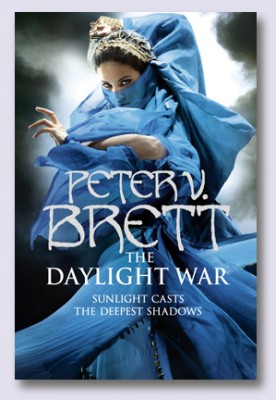
Peter V. Brett - The Daylight War
Peter V. Brett's latest in his epic fantasy series is an eminently readable, but deeply flawed novel. The third (of five) in The Demon Cycle, expect spoilers for books one and two in the plot summary paragraph (and an assumption of familiarity), and probably scattered throughout further analysis. The Daylight War follows the same cast of characters from the first two books, with a notable exception in the depiction of a back-story for Inevera, Jardir's wife and leader of the Dama'ting. Away from this back-story, which covers Inevera's life and training in her Dama'ting ways, as well as providing the reader with a helpful recap of events up to the point the novel is at, the plot is incredibly focused for an 800 page epic on just over a month. Following the Mind Demon attacks at the end of The Desert Spear, both Jardir and Arlen, our two Deliver-elects, are preparing their respective City-states (or equivalent) of Cutter's Hollow and Everam's Bounty to face another waning of the moon. Only this time its personal! Or something like that, anyway.
In typical Epic Fantasy sweep, we follow the minutiae of our main characters as they overcome any and all obstacles in their way, while learning new and better powers in order to defeat the hordes of demons tat are to come at the waning. As per always with Brett's novels, the world building is fantastic - the demons come to life before our very eyes, and the geographies and civic reactions to events are believable and challenging in their own way. At one point, Jardir and his Khaffit childhood friend Ahmann discuss the method of taking the unimaginatively named Lakton, a town, unsurprisingly, in the middle of a lake. This ultra-defensive position will be nigh on impossible to take if well stocked, so, always eager to find a realistic ploy to work around with real-world events, Mr. Brett sends his characters into action to take the equally inspiringly named Docktown at 'First Snow', a time when all the harvest is conveniently gathered in one place before being levied to the Capital. Yes, there are these little conveniences, but with the crushing bureaucracy of running a fiefdom, central, easy-to-manage decision like this make sense, just as taking this harvest makes excellent sense for Jardir's formative nation. It is moments like this, the large-scale decisions and effect that Brett has done well from the outset of his wonderfully premised world.
It is, however, when we get down to the nitty gritty of character and culture that Brett, and in particular this book, falls down. The first two books had their share of the now obligatory fantasy-rape-scene, which is ugly in and of itself, and made more so by the conciliatory muddy shag that followed, to piece the post-gang-rape-very-sad Leisha back together. Because yeah, that'd happen. But, in general, I felt books 1 & 2 dealt altogether OK with gender and sexual issues. Hell, there is even some homosexuality thrown in and it isn't frowned upon. In fact, its considered normal (in the most part. Except when there is a bit of homosexual rape gratuitously thrown in.) But The Daylight War really takes the biscuit when it comes to gender issues in its fantastic setting.
Jared, over on Pornokitsch, gives this utterly compelling Hatchet Job. I'd advise you all to read it, if only to see what a truly wonderful hatchet job looks like, but also because it puts, much better than I do, the gender issues within the book into the open.
For me, the book's main issue with gender is neatly summed up by the last line of chapter 27:
"A great man does not fear his wife will steal his glory. He uses her support to reach even higher"Yup. That's right guys. All a girl is is a leg up, or a leg over at times. They certainly aren't something to worry about if your in power - if there's a powerful woman, she'll be passed around like a tavern wench, like Leisha is, or maybe tied down by strict and nonsensical cultural cliches, like Roger's two wives. And when they have, or develop, a power of their own, be sure that blokes will have got there first, or be in control of it somehow. Like Renna, following Arlen like a puppy and never reaching his ability, nor her potential, as she sacrifices her own free will to be more like him. Or, once again, Roger's two wives who have a magical, mystical power to their voice that can harm demons... But only when Roger controls it. Women have vaginas - that's their only weapon that they can use, and even they are controlled by the whims of men. In a particularly cringeworthy moment at the end of Inevera's training as a Dama'ting, her virginity is taken by a large phallic stone, wielded by the head of the Dama'ting, while the rest of the Dama'ting, all naked and perfectly shave apart from their heads, watch on. Because that's not male-masturbatory fantasy in a nutshell. Following this, Inevera, who has a magical demonbone macguffin that pretty much grants one wish (in a pre-Deliverer culture is one of the most powerful things around) uses it not for protection from harm or as a potential weapon or anything realistically simple, but to remake her hymen. Because a woman who beds a man and is not a virgin is no woman at all. Obviously.
Suffice to say, that gender treatment is dodgy at best.
Aside from that, the treatment of culture is equally dodgy at times. The Krasians are an obvious Islamic analogue, and their depiction is almost at no point a forgiving one. They are depicted as obsessed with fighting demons, with honour above all things, with multiple wives, with females as massively socially inferior (even more so than in the rest of the world). Oh, and they're non-white, so obviously the bad guys. When the cultures blend, it is dealt with well at times, occasionally subtly, and there are moments when you think that these Krasian's might even be becoming somewhat progressive. But for all that, they still think women are objects, men and male children slaves to war, and have no value for artistry or similar. And the only homosexual relations mentioned are within Krasia, which makes me feel as though this is a subtle rebuke against homosexuality, and that it shouldn't, nay couldn't, go on in a civilised society.
And breathe...
And finally. The ending. It's where we should end. Its crap. Jardir and Arlen spend the end of the plot rushing headlong into more and more power, pretty much rendering the last two books exposition, and nothing more as they both become nigh on superhuman: being able to fly, teleport, read minds etcetera. So MAJOR SPOILER ALERT naturally they fight each other and not the demons. Because that's internally consistent. It's all a bit rushed, as though Peter V Brett went 'Oh dear, I seem to have written 750 pages and had the waning most of the plot has been leading up to but don't have a major set piece ending - I'll bung one in for no apparent reason'. I didn't buy it, and I don't see how it isn't going to end in Jardir getting up to fight again, by developing exactly the same powers as Arlen, which he has all along.
In conclusion, then, The Daylight War is a decent-ish book if taken for the plot, and as a follow up if you enjoyed books 1 and 2. There's so much more I could say about it, but the major pitons are all above. It's hard going if you have a conscience about the way the Other than the white, male Anglophone is depicted. Hell, it's hard going full stop past around page 500. I'll pick up books four and five if only because I've invested so much in the story so far, but if your new to the series? Don't start it. It will only disappoint once you get this far.
Overall rating: 2*
Friday, 29 March 2013
Fantasy in the Court at Goldsborough Books
Well... that was fun. Currently lying in bed, somewhat hungover following a lovely evening at Goldsborough books and, of course, the pub afterwards. Not knowing what to expect, and not really knowing anyone, I was grateful to bump into Louise and Julie from Tor.
Away from having the slightly surreal moment where I bumped into the lovely Cat Webb (Kate Griffin) by the coat-sofa, and she revealed who she was and I did a little double take and went 'I'm using you in my dissertation', I enjoyed my mingling. Free wine (in copious amounts) provoked the naturally shy into being talkative and made authors more hilarious than they usually are.
So my thanks to Goldborough Books (of course), as well as Louise Buckley, Anne Perry, Julie Crisp, Tom Pollock, Sarah Pinborough, Andrew Lawston, Francis Knight, Cat Webb, Dave Bradley, Lavie Tidhar, Liz de Jager & husband Mark (surname forgotten!), Jennifer Williams & probably many more I've forgotten. It was lovely to meet you all for the first time or again.
While 90% of those there were industry in some way or other, everyone was lovely, mingling was easy (once you got used to the lack of oxygen caused by a large amount of humans in a space not designed for that many humans), and those of us who are simply unapologetic fanboys were more than welcome.
However, the most important and exciting part of my evening was, of course, Lavie Tidhar signing my copy of Osama (when he took a short break from reminding Francis Knight and I of his multiple awards he'd won). He might not forgive me for this, but he was somewhat inebriated, and said inebriation made its way into my signing. So, for those of you who haven't seen, I proudly present:
Which, translated, reads:
Of course, we must remember that he does write lies for a living...
So not only the best inscription I've ever received in a book, but will one day be worth millions... I can only hope every book I get signed in future has such a wonderful inscription. Thank you Lavie!
Well... that was fun. Currently lying in bed, somewhat hungover following a lovely evening at Goldsborough books and, of course, the pub afterwards. Not knowing what to expect, and not really knowing anyone, I was grateful to bump into Louise and Julie from Tor.
Away from having the slightly surreal moment where I bumped into the lovely Cat Webb (Kate Griffin) by the coat-sofa, and she revealed who she was and I did a little double take and went 'I'm using you in my dissertation', I enjoyed my mingling. Free wine (in copious amounts) provoked the naturally shy into being talkative and made authors more hilarious than they usually are.
So my thanks to Goldborough Books (of course), as well as Louise Buckley, Anne Perry, Julie Crisp, Tom Pollock, Sarah Pinborough, Andrew Lawston, Francis Knight, Cat Webb, Dave Bradley, Lavie Tidhar, Liz de Jager & husband Mark (surname forgotten!), Jennifer Williams & probably many more I've forgotten. It was lovely to meet you all for the first time or again.
While 90% of those there were industry in some way or other, everyone was lovely, mingling was easy (once you got used to the lack of oxygen caused by a large amount of humans in a space not designed for that many humans), and those of us who are simply unapologetic fanboys were more than welcome.
However, the most important and exciting part of my evening was, of course, Lavie Tidhar signing my copy of Osama (when he took a short break from reminding Francis Knight and I of his multiple awards he'd won). He might not forgive me for this, but he was somewhat inebriated, and said inebriation made its way into my signing. So, for those of you who haven't seen, I proudly present:
Which, translated, reads:
Dear Max,
My penis is bigger than yours.
Lavie Tidhar
Of course, we must remember that he does write lies for a living...
So not only the best inscription I've ever received in a book, but will one day be worth millions... I can only hope every book I get signed in future has such a wonderful inscription. Thank you Lavie!
Thursday, 28 March 2013
Ian Sales - Adrift on The Sea of Rains
Ian Sales - Adrift on The Sea of Rains (Whippleshield Books)
I picked up Ian Sales' novellette (novella? - its around 25,000 words...) because of its nomination for the BSFA short story award, and the accompanying article from Niall Alexander on Tor.com'sShort Fiction Spotlight, which reviewed it rather favourably. I must say, I really like Niall's reviews, and he's one of those people I look to before buying a new book.
The short story looks to be one of the frontrunners for the award, and I must say that its an entirely deserved viewpoint. Sales writes the claustrophobic and the tense with a knowing eye, casting the reader into the mind of the alienated main character, Commander Peterson, with aplomb.
Adrift takes us straight into a bleak alternate history, one where Peterson and his crew are stuck on the moon after a nuclear holocaust wipes out the Earth. Reliant on the 'Wunderwaffe Device', or the 'Bell', an untested device to traverse parallel universes, the occupants of the moon, for all we know the only surviving humans, are fast running out of hope.
Away from the alt-hist mode and vaguely fantastical Bell ("Any technology sufficiently advanced..."), Sales' looks to the extremes of Hard Sci-Fi to power his work. Now, I don't normally enjoy Hard Sci-Fi unless its done really, really well (as in Peter Watts' Blindsight,to give an example), but this really does it well. There is a large appendix and glossary of terms at the back (which is almost as fascinating to read as the story itself), which I found myself referring to - a little too frequently at times, as the constant stream of acronyms can sometimes take away from the story. But the realism grounds the novel, takes it away from the typical, from the relatively poor 'Golden Age' moon landing stories, even away from recent attempts. Coupled with the claustrophobia we see from our one and only vantage point, it allows for the separation of Sales' narrative from what has gone before it in what must be admitted to be a trope of SF.
It is precisely because Sales is dealing with a trope that the novella feels so fresh. The present tense used in both timelines of the story (intriguingly alternating between italicized and non-italicized fonts) keeps the reader feeling the tension of Peterson, while the jargon causes a deliberate juxtaposition: a sense of the reader without, just a layperson would feel looking in at an astronaut. Oh sure, if you happen to be in the USAF, you'd probably get 80% of the terms used, but otherwise? Not a chance. This juxtaposition, to me, only emphasized Peterson's claustrophobia and separation: from his fellow crewmates ("despair has made strangers of them") and from the rest of humanity by virtue of the predicament in which the astronauts find themselves.
At times this separation becomes a little too much - we don't see much of the other crewmates, they are there as tools for the plot, realistic necessities. They are sketched in brief, which it feels is how Peterson views, them, but at times this brevity can be somewhat hostile, I found myself more than once wanting to know more than I was given.
While the text is entirely male, Sales has revealed on twitter that this is deliberate and that, as part of a series of four, women will slowly become more and more central as the series progresses: perhaps a comment on the archaisms of those stories that formed the trope itself, but we will have to see.
In essence; don't be put off by the hardness of this trope SF tale; it reveals something fresh, something exciting, a storyof ideas that has a character and his feelings at its heart.
Overall Rating: 4.5*
Addendum: I have yet to read the sequel, The Eye with Which the Universe Beholds Itself, which is now out, but will soon, in between my other reading and review it here.
I picked up Ian Sales' novellette (novella? - its around 25,000 words...) because of its nomination for the BSFA short story award, and the accompanying article from Niall Alexander on Tor.com'sShort Fiction Spotlight, which reviewed it rather favourably. I must say, I really like Niall's reviews, and he's one of those people I look to before buying a new book.
The short story looks to be one of the frontrunners for the award, and I must say that its an entirely deserved viewpoint. Sales writes the claustrophobic and the tense with a knowing eye, casting the reader into the mind of the alienated main character, Commander Peterson, with aplomb.
Some days, when it feels like the end of the world yet again, Colonel Vance Peterson, USAF, goes out onto the surface and gazes up at what they have lost.
Adrift takes us straight into a bleak alternate history, one where Peterson and his crew are stuck on the moon after a nuclear holocaust wipes out the Earth. Reliant on the 'Wunderwaffe Device', or the 'Bell', an untested device to traverse parallel universes, the occupants of the moon, for all we know the only surviving humans, are fast running out of hope.
Away from the alt-hist mode and vaguely fantastical Bell ("Any technology sufficiently advanced..."), Sales' looks to the extremes of Hard Sci-Fi to power his work. Now, I don't normally enjoy Hard Sci-Fi unless its done really, really well (as in Peter Watts' Blindsight,to give an example), but this really does it well. There is a large appendix and glossary of terms at the back (which is almost as fascinating to read as the story itself), which I found myself referring to - a little too frequently at times, as the constant stream of acronyms can sometimes take away from the story. But the realism grounds the novel, takes it away from the typical, from the relatively poor 'Golden Age' moon landing stories, even away from recent attempts. Coupled with the claustrophobia we see from our one and only vantage point, it allows for the separation of Sales' narrative from what has gone before it in what must be admitted to be a trope of SF.
It is precisely because Sales is dealing with a trope that the novella feels so fresh. The present tense used in both timelines of the story (intriguingly alternating between italicized and non-italicized fonts) keeps the reader feeling the tension of Peterson, while the jargon causes a deliberate juxtaposition: a sense of the reader without, just a layperson would feel looking in at an astronaut. Oh sure, if you happen to be in the USAF, you'd probably get 80% of the terms used, but otherwise? Not a chance. This juxtaposition, to me, only emphasized Peterson's claustrophobia and separation: from his fellow crewmates ("despair has made strangers of them") and from the rest of humanity by virtue of the predicament in which the astronauts find themselves.
At times this separation becomes a little too much - we don't see much of the other crewmates, they are there as tools for the plot, realistic necessities. They are sketched in brief, which it feels is how Peterson views, them, but at times this brevity can be somewhat hostile, I found myself more than once wanting to know more than I was given.
While the text is entirely male, Sales has revealed on twitter that this is deliberate and that, as part of a series of four, women will slowly become more and more central as the series progresses: perhaps a comment on the archaisms of those stories that formed the trope itself, but we will have to see.
In essence; don't be put off by the hardness of this trope SF tale; it reveals something fresh, something exciting, a storyof ideas that has a character and his feelings at its heart.
Overall Rating: 4.5*
Addendum: I have yet to read the sequel, The Eye with Which the Universe Beholds Itself, which is now out, but will soon, in between my other reading and review it here.
Saturday, 16 March 2013
1853 - Various Authors
1853 - Various Authors (Chapbook, published by Pornokitsch/Pandemonium Fiction)
1853 is a chapbook published by the lovely guys over at Pornokitsch, featuring 3 stories set in the same universe as their major anthology of last year, A Town Called Pandemonium. The brief, as detailed on the Pornokitsch website, was for slightly alternate histories set in the same year as A Town Called..., which, you guessed it, is 1853. The book feature 3 short short-stories; 2 by first-time published authors in Laura Graham and Marc Aplin (the guy behind the fantastic Fantasy Faction), and one by multi-published Jonathan Green. As the stories are small, and there are only three of them, I thought I'd review them singularly, before setting out my overall impressions. As I have yet to read A Town Called Pandemonium (its on the shelf, on the TBR), my impressions of it with regard that anthology can't be said, but suffice to stay it stands alone well.
The Gunslinger - Marc Aplin
The chapbook opens with Aplin's tale set in the Taiping Rebellion of Hong Xiuquan, a southern Chinese who claimed to be the brother of Jesus Christ. An interesting tale of human conscience, Aplin's battle between an unnamed gunslinger and his actions resonates with all of us who have stood before a difficult choice and had to pick. While the prose is at times stilted, the mark of a first time author, the backdrop of the scene is given to us neatly in broad brushstrokes, and creates an oriental air with ease - perhaps reflecting the author's experience in the Far East. It is also the most subtle of the stories when it comes to the fantastical or supernatural events. The only reflection upon such events is the ending, an intriguing and mystical turn that begs its readers to ask questions, to both believe and disbelieve the central premise of Hong's rule. In terms of story, this, I felt was the best.
Bat out of Hell - Jonathan Green
Ridiculously cliche and unnecessary title aside, Green's novel is clearly the work of an already-published author, though one would hope his editors change his titles usually if they are all that bad. His prose is impressive, sweeping the reader through swiftly, with dialogue and description functioning well within the limited space of the short story ( a mere two pages of my kindle-for-iPad). And yet, the story as a whole just didn't draw me in. Well constructed, well devised within a framework of legend-action-'normal' perspective of aftermath, yet the plot as whole didn't feel appropriate to a short story, but elaborating in a longer piece. Even then, the ideas felt old, cliched; the awakened legend demanding life in return for salvation. Further, while the other two stories within the piece had a feeling of 1853 within them, this didn't feel like the past, but rather the present: the journalistic aspect, as well as the MCs voice coming across as far too contemporary for my liking. Despite this, as I've said, the execution was good, and it is a worthy addition to the chapbook simply through its writing style, which is excellent.
Islands to Auld Reekie - Laura Graham
The standout of the chapbook for me, Islands to Auld Reekie is a heartbreaking letter from a young daughter in Edinburgh to her mother on the Isle of Skye. Again, the work of first-time-author is evident at times through the prose, but Graham pulls off a great piece with the sheer humane aspects of the story. As well as contextualising the expulsion of 'peasants' from the Isle of Skye, Islands to Auld Reekie also touches upon a horror that lurks in the outskirts of newly industrial Edinburgh. It is the naivety and softness of Graham's main character that captures the heart and the hope-against-hope that what is obvious to the reader has not actually occurred. The format as well is a masterful stroke, the letter giving just enough of a glimpse into the life of the MC for the short short-story format, but at the same time giving her nature away without excessive need for backstory: Aplin's first person narrative strives toward this deftness but doesn't quite reach it.
Overall
1853 is a very nice publication, and won't take you at all long to read (I read it on a bus journey...). The biblical quotes at the end of each story give an idea of continuity, and shared-world, without being overly forced. However, given the nature of the biblical quote in Aplin's story (brilliantly used within the constraints of having biblical quotes at the end of each), I'd have like to have seen it placed at the end of the anthology, as opposed to the start, to give the reader a sense of completion & understanding.
Further, while I enjoyed Jonathan Green's piece (though, as said above, I found it to be the weakest story-wise), and don't question its worthiness to go in the chapbook, I'd've like to have seen 1853 as an attempt by the Pornokitsch bunch to introduce to never-before published authors of the manner of Laura Graham and Marc Aplin - these anthologies are perfectly placed to give promising young authors both a leg up and a much needed confidence boost for their writing.
Overall Rating: 4*s
Subscribe to:
Posts (Atom)